Analyze the chemical composition of rare earth metal raw materials, including industrial pure iron, Fe-B alloys, and other metals such as Ga, Al, Nb, Zr, etc.
Analyze the chemical composition of the magnet, including rare earth elements such as Nd, Pr, Ce, Dy, Ho, Gd, Tb, and other metal elements such as Cu, Al, Nb, Zr, Ga, Co, Ti, etc.
Analyze the content of other non-metallic elements such as hydrogen, oxygen, carbon, etc.
Vacuum Melting Furnace
The mixed metals are melted under argon gas protection at high temperatures. The melt is then rapidly cooled using strip casting, ensuring uniform distribution of the product’s components. This process produces strips with a thickness of 0.15-0.75mm, which are then prepared for the next step in the hydrogen decrepitation furnace.
Hydrogen Decrepitation Furnace
The strips are placed in a hydrogen decrepitation furnace (specialized equipment), where a vacuum is created to below 10⁻² Pa and then filled with high-purity hydrogen gas. This causes the NdFeB material to absorb hydrogen and fracture. Once completely fractured, the material is heated to undergo a dehydrogenation reaction, resulting in NdFeB powder particles of approximately 100-1000μm. This powder is then prepared for jet milling.
Jet Mill
The hydrogen-decrepitated strips are mixed with a certain proportion of antioxidant and then added to the feed hopper of the jet mill. The material is fed quantitatively into the milling chamber, where high-pressure nitrogen gas (7 kg) is injected through four nozzles, accelerating the material to supersonic speeds and forming a fluidized bed. The particles collide with each other and break down, resulting in a particle size distribution of 2-4μm.
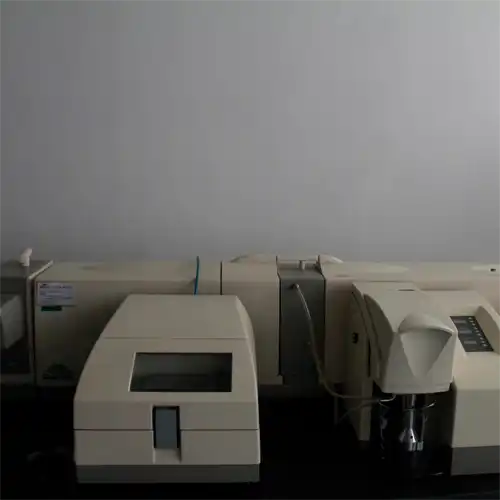
Laser Particle Analyzer
A laser particle size analyzer uses the diffraction or scattering pattern (scattering spectrum) of particles to analyze the particle size of NdFeB powder. This helps determine whether the jet mill has successfully ground the NdFeB powder to the desired size. If the particles are too large, the consistency of the magnet’s performance will decrease, leading to uneven magnetic force distribution.
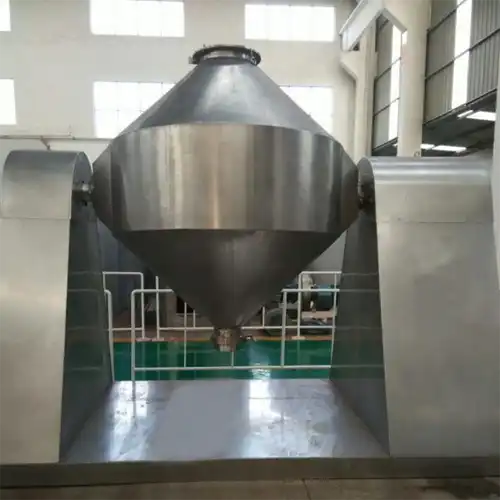
Powder Mixer
The neodymium iron boron (NdFeB) powder is stirred and mixed to improve uniformity, ensuring that both large and small particles are evenly distributed. This process ensures uniform powder distribution and product consistency.
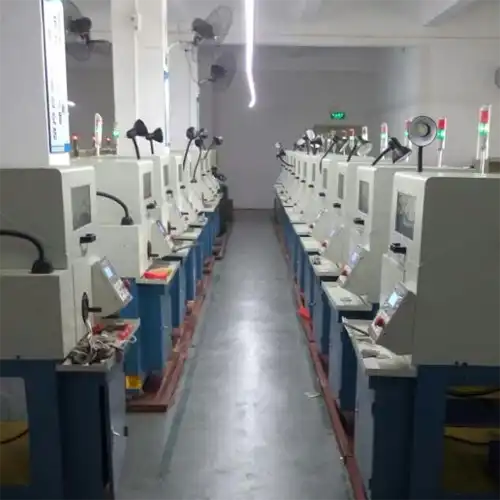
Automatic Press Machine
The NdFeB powder is filled into a mold and placed in an automatic magnetic press. A strong electromagnetic field is usually applied horizontally while pressure is applied vertically to compact the powder, forming the NdFeB blank. The molds can be cylindrical or rectangular, and the magnetization direction of the magnet is determined during this process.
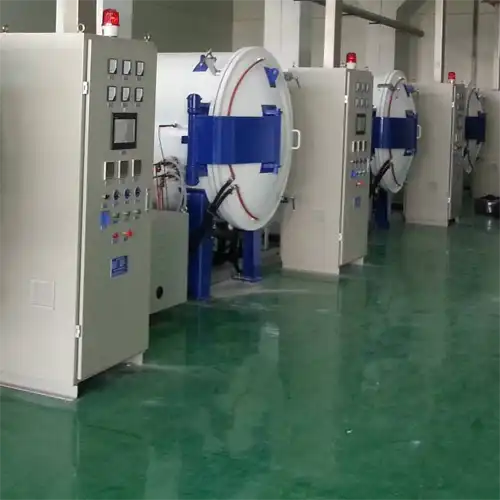
Vacuum Sintering Furnace
To further increase density, improve the contact properties between powder particles, and enhance strength, the pressed compact is heated to near the melting point of the powder for a period of time. This process, known as sintering, results in a microstructure with high permanent magnetic properties. After sintering, the magnet undergoes rapid cooling, which can cause uneven grain boundary distribution and unclear grain boundaries. Therefore, a tempering treatment at a specific temperature is required to optimize the microstructure.
Inner Circular Cutting Machine
The neodymium iron boron (NdFeB) is cut automatically using a high-speed rotating thin inner-diameter diamond saw blade. Cutting oil is used as the cooling lubricant during the slicing process. The advantage of this method is that it does not require custom tools, offering strong flexibility, making it suitable for sample processing and small batch cutting. However, due to its low processing efficiency, low material yield, and weak ability to ensure verticality, this method has gradually been replaced by multi-wire cutting machines (wire saws) for mass production.
Multiple Wire Cutting Machine
Using fixture tools to secure workpieces onto the workbench, a rotating diamond wire (with a diameter of 0.15~0.2mm) is used in conjunction with abrasive slurry to cut through the magnet blank. Cutting fluid is applied to cool the cutting process. This method allows simultaneous cutting of multiple workpieces, ensuring high production efficiency, yield, and material usage. It also offers strong verticality assurance, making it suitable for continuous batch processing. However, it requires customized rollers for different product specifications.
Drilling Machine
Using fixture tools to secure workpieces onto the workbench, a rotating diamond wire (with a diameter of 0.15~0.2mm) is used in conjunction with abrasive slurry to cut through the magnet blank. Cutting fluid is applied to cool the cutting process. This method allows simultaneous cutting of multiple workpieces, ensuring high production efficiency, yield, and material usage. It also offers strong verticality assurance, making it suitable for continuous batch processing. However, it requires customized rollers for different product specifications.
Magnetizing Machine
A magnetizer is a tool used to magnetize magnetic materials or magnetic devices. It applies a magnetic field to permanent magnetic products that need to be magnetized. If the magnetic field during magnetization does not reach the technical saturation level, the residual magnetism (Bj) and coercive force (Hcj) of the permanent magnet may not achieve their required values.